La Prensa San Diego News Desk
An aggressive law firm representing a local photographer threatened to file a lawsuit against La Prensa San Diego (LPSD) for using a picture of controversial real estate broker Jason Hughes, but they dropped the matter after misrepresented the illegality of using the image.
A law firm representing San Diego-based photographer John Francis Peters sent LPSD a letter claiming violations of federal copyright laws for using a picture of Hughes taken by Peters, and demanded payment of $3,750 for the use of the image.
LPSD used the picture in a May 13, 2024, online article about Hughes having filed an appeal of the California Department of Real Estate (DRE) decision to revoke his real estate license after he was convicted of a misdemeanor charge of wrongfully receiving over $9.4 million in two lease transactions between the City of San Diego and Cisterra Development.
The picture first appeared in a June 5, 2020, article in the New York Times detailing how office tenants were renegotiating their leases during the COVID pandemic.
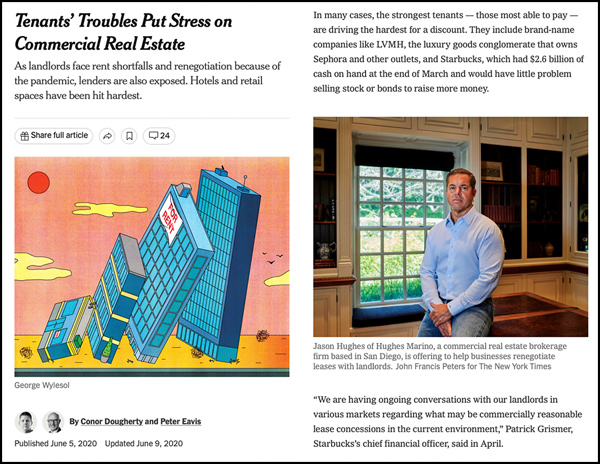
New York Times article featuring picture by John Francis Peters
LINK TO ARTICLE
Hughes, Co-CEO of Hughes Marino, a San Diego-based real estate brokerage firm, was mentioned in the New York Times article along with several other people associated with the story. The picture appeared only in their online version, but not in their national print newspaper. The New York Times gave a photo credit to Peters.
After that article, Hughes became a central figure in two controversial real estate transactions where the City of San Diego leased, then purchased, two downtown buildings from Cisterra. Hughes was serving as an unpaid real estate broker for the City and helped negotiate both deals.
One of the buildings was the 101 Ash Street tower, which the City had leased in 2016 before discovering it was unusable due to toxic asbestos exposure.
After the City evacuated the building in January 2021, the process that led to the 20-year lease-to-own deal was reviewed by the City.
In September of that year, LPSD learned from well-placed sources that Hughes had secretly been paid backend fees by landlord Cisterra, who executed the two leases with the City.
Hughes had promoted his real estate business as “tenant-only representation” and wrote his own article just days after the Times story where he claimed his firm was “bound by a moral code to provide our clients with the best non-conflicted, transparent and independent representation possible.”
After several attempts to reach Hughes to confirm he had been paid by Cisterra and having received no responses or denials, LPSD was the first news outlet to publish that Hughes had been paid by Cisterra.
Several months later, after the City of San Diego sued Cisterra and its financiers to unravel the two building purchases, Hughes admitted that he had been paid over $9.4 million in the two transactions without publicly disclosing the fees.
The City was suing to unravel the purchase of 101 Ash and force Cisterra to take back the unusable building.
San Diego District Attorney Summer Stephan then charged Hughes with a felony violation of the state’s conflict of interest laws, known as Government Code Section 1090, for having been involved in negotiating the leases in which he also stood to gain financially.
Hughes argued that he had notified then-Mayor Kevin Faulconer’s office that he would seek compensation on the deals, but Hughes never officially disclosed to the City that he had negotiated payments from Cisterra or that he had received the payment after the deals closed.
Hughes eventually agreed to a deal with prosecutors by pleading guilty to a single misdemeanor Section 1090 count, agreed to return the $9.44M in undisclosed payments in had received, and paid a $400 fine.
The City later bought the 101 Ash building from Cisterra and its financiers to end the litigation. In total, the City has spent more than $200 million on the 101 Ash St. building which was valued at $67.1 million before the City leased it in 2016.
The 101 Ash building remains unoccupied to this day.
COPYYRIGHT LAWS
LPSD received a letter from the Las Vegas-based law firm of Higbee and Associates on August 8, 2025, stating that they represent Peters who holds the copyright for the picture.
The legal letter claimed “the use of the work is a violation of The Copyright Act, Title 17 of the United States Code” and threatened that Peters “will ask for the maximum justifiable damages” and “may also ask the court to order La Prensa San Diego to pay their attorneys fees and court costs.”
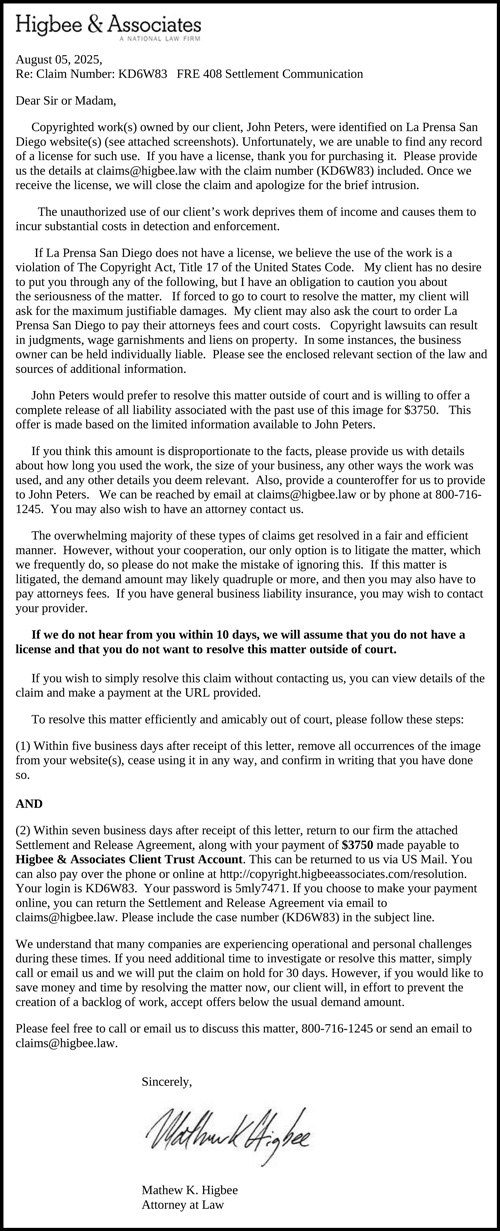
Higbee & Associates demand letter to La Prensa San Diego
The law firm offered a "complete release" for a payment of $3,750 and threatened that “if this matter is litigated, the demand amount may likely quadruple or more, and then you may also have to pay attorneys fees.”
Under federal copyright laws, photos are protected from the moment they are taken and the ownership conveys to the photographer unless ownership of the image is transferred in writing.
But the Copyright Act of 1976 also includes exceptions to violations of the copyright laws under the fair use doctrine, which specifically states that using protected works “for purposes such as criticism, comment, news reporting, teaching (including multiple copies for classroom use), scholarship, or research is not an infringement of copyright.”
LPSD responded to the legal letter by explaining that the image was used “consistent with the standards of free use of copyrighted material for news reporting and criticism. We did not commercialize or repurpose the photo beyond its use within a news story.”
The letter also offered to either take the picture down from the online story or to give Peters appropriate credit for the image, but did not offer to pay the $3,750 demanded in the initial letter.
LPSD also asked the law firm the provide the “the document number and date of recordation of his filing [of a copyright registration] for our records.”
Although copyright protection exist from the moment the image is taken, the owner must file and record a copyright for each specific photograph in order to be able to file a lawsuit in federal court, to seek statutory damages, and to win reimbursement of legal fees.
If the registration is completed after an alleged violation of the copyright, the owner can only seek actual damages resulting from the non-licensed use of the image, which are difficult to prove.
Higbee lawyer Theodore “Ted” W. Sell responded by claiming LPSD’s letter “makes the infringement extremely clear as you did not even attempt to gain authorization before using someone else's work” and that Peters has the "exclusive right to use their work and any unauthorized use is then infringing, for which civil damages arise.”
Sell also ignored LPSD's request for the document number and recordation date of the copyright, instead responding that “copyright protection begins with creation of the work, not the registration of the copyright” and that Peters “reserves the right to locate the registration and pursue statutory damages and attorney’s fees – if the registration is timely – or register the copyright and seek the actual damages upon which the demand is based.”
A search of the federal copyright database does not show a copyright registration for Peters' image of Hughes.
After the exchange with Sell, LPSD reached out to Peters to discuss the photo and his legal threat of a lawsuit.
Peters did not reply to multiple phone and email messages.
Instead, Sell emailed LPSD saying they would “close this matter” and asked to “now cease contacting” Peters.
“I just spoke with Mr. Peters. It was decided to close this matter despite that you had no authorization from him to use the image he created. Please now cease contacting him,” the letter reads.
LPSD contacted Sell by phone to confirm his office would be drop the matter and not pursue legal action.
FAIR USE DOCTRINE
The fair use doctrine outlined in Section 107 of the Copyright Act of 1976 specifically names news reporting as a protected use of copyrighted material.
"Notwithstanding the provisions of sections 106 and 106A, the fair use of a copyrighted work, including such use by reproduction in copies or phonorecords or by any other means specified by that section, for purposes such as criticism, comment, news reporting, teaching (including multiple copies for classroom use), scholarship, or research, is not an infringement of copyright."
The Section also includes four factors used in determining whether the use made of a work in any particular case is a fair use: (1) the purpose and character of the use, including whether such use is of a commercial nature or is for nonprofit educational purposes; (2) the nature of the copyrighted work; (3) the amount and substantiality of the portion used in relation to the copyrighted work as a whole; and (4) the effect of the use upon the potential market for or value of the copyrighted work.
A 2023 federal case in New York involving news reporting was dismissed before trial on the basis of the fair use doctrine.
In that case, Robyn Brody, a freelance photojournalist, sued Fox Broadcasting Corp after a Florida affiliate station aired still images from a video Brody shot during the January 6, 2021, attack on the US Capitol Building in Washington, D.C. The Fox35 station did not secure any licensing rights from Brody.
Fox filed a motion to dismiss before trial claiming the fair use doctrine for news reporting.
The court ruled in favor of Fox, dismissing the case, citing that the evidence of fair use was “so clearly established on the face of the amended complaint and its incorporated exhibits as to support dismissal.”
In another case, a federal appeals court in Virginia ruled against a media outlet for using a picture in what was judged not to be news reporting.
The US Court of Appeals for the Fourth Circuit ruled against the Independent Journal Review (IJR) which used a picture of singer Ted Nugent taken by photographer Larry G. Philpot.
The IJR used the picture in an ad-sponsored editorial article titled "Signs Your Daddy Was a Conservative" and listed liking Nugent as one of the "signs" along with Philpot's picture of Nugent. The IJR earned less than $5.00 in ad revenues from the article.
Philpot had already registered the image with the US Copyright office and offered a free license to use the picture through WikiCommons as long as users gave Philpot a photo credit and linked to his photograph website. The IJR did not provide any photo credit or link.
The Court ruled that the use was not protected by the fair use doctrine, was commercial, and was not transformative. The use was not for news reporting, but more for commercial content creation.
LAW FIRM CONTROVERSIES
The law firm of Higbee and Associates has been criticized as a "copyright troll" and "copyright enforcement law firm" that has sent thousands of demand letters to website owners and bloggers who have used pictures without licensing the images.
Several online posts detail the aggressive demand letters and threats made by Higbee lawyers who have demand as little as $200 to settle claims, but also threatening to seek damages as high as $150,000 in statutory damages and attorney fees in some cases.
One online post said Higbee demanded a $4,000 payment for two photos used on a company website more than 13 years earlier.
Online posts include very similar descriptions of demand letters seeking payment, along with similar proposed settlement agreements and credit card payment forms.
A Florida-based law firm, Heitner Legal, advertises that it has "helped thousands of clients" who received demand letters from the law firm.
"Over many years, we have assisted thousands of clients who felt hopeless and lost when they received copyright infringement demand letters from Higbee & Associates. Unfortunately, some people simply paid Higbee before we were involved. The others, who were smart enough to contact us, have all either greatly negotiated down the initial demand amount with our assistance or made Higbee & Associates go away altogether."
Another lawyer, Jonathan Phillips, in Peoria Heights, Illinois, advertises his services to defend companies against "serial litigants," including Higbee.
"Higbee & Associates does appear to represent photographers. But, their business model—send a ton of demands and collect money—is somewhat suspect. Their letters are pretty thin," Phillips' website states.
The Higbee & Associates website lists "Copyright Enforcement" under its services, and lists three cases as "Sample Successes" including a "Jury verdict of $1,175,000 for unlicensed use of single nature photo", a "Settlement for $550,000 for unlicensed use of 22 stock photos", and a "Settlement for $240,000 for unauthorized use of 2 photo shoots."
The $1.175 million verdict was for an image taken by photographer Dennis Fugnetti used by a company on its product package material for over 15 years after ending its relationship with Fugnetti's marketing company.
The law firm does not provide any details for the two other "Successes" on its website.
Another case Higbee promotes was against a mortgage company sued for using two photos on its website without securing licensing rights from the photographer, but, because the company did not respond to the lawsuit, Higbee's client was awarded a default judgment by the Court, along with injunctive relief to stop the mortgage company from using the images, $17,500 in statutory damages, $1,650 in attorneys' fees, and $643 in court costs.
None of the cases on Higbee's website involved a media outlet using an image for news reporting or criticism covered by the fair use doctrine.