Arturo Castañares
Publisher
The City Manager of Chula Vista is trying to raid funding from the City’s special public safety sales tax measure passed by voters in 2018 to recover over $1.2 million in legal fees incurred during its recent police drone video lawsuit.
On Thursday night, City staff made a proposal to the Measure A Citizens’ Oversight Committee to codify that any legal expenses related to services funded by Measure A should be paid by the special funding.
The Citizens’ Oversight Committee, made up of 9 community representatives, was set in place as part of the voter-approved Measure A --a 1/2-cent sales tax increase passed in June 2018-- to monitor that expenditures made from the funding are consistent with the ballot measure’s language.
The ballot initiative, known as Measure A, was passed by Chula Vista voters by a margin of 52.5% to 47.5%. The new 1/2-cent tax is permanent unless and until another ballot measure repeals it, and is in addition to Measure P passed in 2014 and renewed in 2024, which is an additional 1/2-cent sales tax to fund infrastructure projects and city services.
The exact ballot language of Measure A seemed to promise that the funding would be used solely for public safety, but the City’s politicians left themselves a backdoor to raid the funds for any “lawful” purpose.
“Shall the measure to provide: faster responses to 9-1-1 emergency calls, increase neighborhood police patrols, reduce gang and drug-related crimes, address homelessness, improve firefighter, paramedic and emergency medical response, and general city services, by enacting a ½ cent sales tax, until the voters decide otherwise, generating an estimated $17 million annually for City services, with all funds staying in Chula Vista, with citizen oversight and independent audits, be adopted?
You see, the language first seems to promise that the money will only be used for emergency services, patrols, reducing crimes, and improved response times, but then adds three little words that eviscerate the previous commitments: general city services.
By including the term “general city services” in Measure A, the tax increase of was NOT a dedicated tax measure so it only required a majority vote, not the higher 2/3 super majority vote required for tax increases which can only be used for dedicated purposes, ie, roads, public safety, etc.
The broader language legally allows the City to use the Measure A funds for any “lawful” general City services, which means pretty much any expense at the City, from police and fire, to pencils and toilet paper.
But, when the City was trying to persuade the public to vote for Measure A, it made political promises that sure sounded like the funding would only be used to make the City safer, and only quietly let voters know they could do whatever they wanted with the new money.
For example, then-Chula Vista City Attorney Glen Googins’ official ballot arguments submitted for voters included language saying “The City Council has expressed its intent to spend these monies exclusively on critical needs of the City's police and fire departments. However, because the tax is a “general purpose” tax, the City Council would reserve the right to spend the tax revenues for any lawful City purpose.
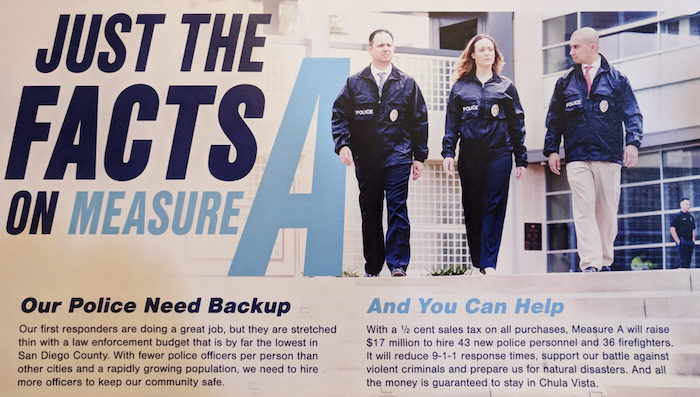
A campaign mailer sent to voters during the 2018 election specifically promised that "all the money is guaranteed to stay in Chula Vista" yet now they want to raid the funds to pay for outside lawyers.
This week, it was the new City Attorney, Marco Verdugo, who attended the Citizens’ Oversight Committee meeting and argued that it would be legal to use the special tax increase funding to reimburse the City for over $1.2 million in legal fees it incurred in fighting a lawsuit that sought the release of police drone videos.
For reference, the lawsuit only came about after the City rejected a California Public Records Act request I made for copies of police drone videos to review how the police was flying drones over our homes.
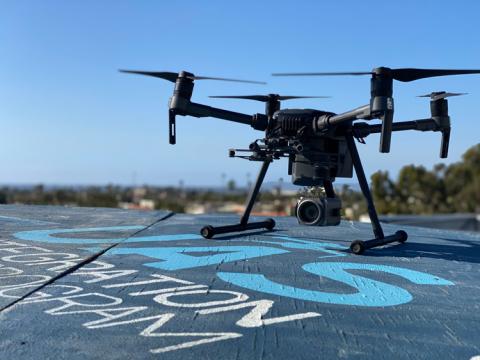
Chula Vista had become the first police agency in the country authorized by the FAA to fly drones beyond the line of sight of the operator; they can fly anywhere in the City with the operator being in a windowless office in the CVPD headquarters miles away.
When I made my request, I specifically asked them to exclude any videos connected to actual investigations, as that is what existing law already required.
My request posed no threat to the drone program, nor was I trying to limit or end the use of drones as a valuable tool to help officers do their jobs more effectively, and, most importantly, more safely.
But the City immediately denied my request and argued that ALL police drone videos are exempt from disclosure to the public, even if they show no police activity at all. This was clearly an unreasonable position to take.
Our request was upheld by the California Appeals Court, setting a new statewide precedent that police can only restrict the disclosure of records tied to investigations, but must release other non-exempt records.
The City then chose to appeal to the California Supreme Court which quickly rejected their petition for review.
But then, after a local judge reviewed the videos himself and ordered the release of 25 videos from the ones I requested, the City again petitioned the Appeals Court and, after that court again upheld our case, the City appealed to the California Supreme Court again and lost...again.
When the local court finally ordered the release 25 videos from just one month out of 7 years of drone flights, there was really nothing in the videos worth hiding. One video for a reported car accident found no cars there. A video from a reported fire found no fire. One video of a call for help only showed paramedics actually helping a resident. This was a waste of time and, more importantly, taxpayer dollars.
All of this --which is now a total of $1.2 million-- was the City simply trying to keep videos from the public. They had no upside in fighting this case except to hide how drones are becoming part of a large surveillance system that includes automated license plate readers, street light cameras, facial recognition software, and AI searches.
After the lawsuit, the City was ordered to reimburse my lawyer over $500,000, and they were charged over $700,000 by their outside lawyers, not counting any internal costs for work within the City Attorney’s office.
This case should have never been a battle. It was a colossal waste of taxpayer dollars because of bad legal advice by Googins and City Council members who blindly followed him down that path, not to mention police leadership who bristled at the fact that someone would challenge their authority.
But, enough is enough.
The City must pay the legal fees either way, but they are trying to raid public safely funding instead of cutting some other waste in the City.
Instead of allowing the City to drain Measure A public safety revenues for legal fees, maybe Chula Vista taxpayers should be asking the City Council why they supported fighting the release of non-investigative drone videos to the public in the first place. Transparency enforces accountability.
Mayor John McCann, Councilmember Jose Preciado, Councilwoman Carolina Chavez, and City Attorney Marco Verdugo are all up for re-election this year.
Don't allow them to throw good money after bad.
Voters approved Measure A to fund services that save lives and make our City safer, not to pay lawyers on cases that are the follies of politicians.