La Prensa News Desk
March 11, 2026
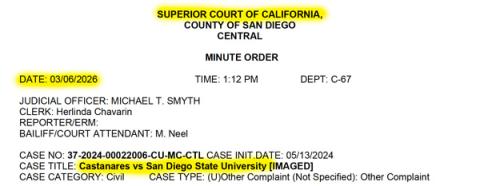
La Prensa San Diego Publisher Arturo Castañares won a lawsuit last week against San Diego State University over its failure to release documents related to an offer for a free sports arena in Mission Valley, with the judge admonishing the University’s lawyer for making “uncivil” comments about Castañares in an official court filing.
The lawsuit was filed after SDSU failed to provide records Castañares requested about a trip to Texas taken by SDSU officials and local civic leaders to tour the University of Texas sports arena in Austin in May 2021.
That trip was scheduled by Oak View Group, which developed the Austin arena, and had indicated interest in entering into a similar deal with SDSU to build and operate a sports arena alongside Snapdragon Stadium at no cost to the University.
The disclosure of the trip and subsequent offer of interest from Oak View Group helped put important events regarding a potential sports arena in San Diego into perspective.
After the trip to Texas in May 2021, California State University trustee Jack McGrory, who went on the trip, met with San Diego Mayor Todd Gloria to relay the news about a potential deal for a new sports arena.
McGrory later testified in a sworn deposition that Gloria asked him not to pursue the offer because he was about to move forward with an alternative plan at the existing site of the Sporta Arena in the Midway area of the City.
Four months later, Gloria pushed City staff to select Zephyr Partners to lead the new sports arena project known as Midway Rising. Zephyr CEO Brad Termini and his wife had donated $100,000 to Gloria’s election campaign in 2020. City sources told La Prensa San Diego before Zephyr was selected that they were not allowed to properly vet the company because the Mayor had already determined which company he would choose.
That project proposal, which also included thousands of housing units and commercial retail space, would require tens of millions of taxpayer dollars in the form of bonds to help subsidize the deal, compared to a no-cost-to-taxpayers deal proposed in Mission Valley. The City is still in an exclusive negotiating agreement with Zephyr.
At the time Castañares filed requests under the California Public Records Act, no media had reported on the undisclosed trip to Texas, and Castañares was unsure of the name of the group that had made the offer, so he made his request broad enough to cover any potential companies or names of groups.
His request for “Any document related to any proposal, offer, or other conveyance of interest received by SDSU from any group, company, or individual in developing an arena or other similar facility within the SDSU Mission Valley site since January 1, 2021” was broad enough to encompass documents from any group.
But SDSU failed to provide all documents related to the offer, so Castañares initiated the lawsuit to compel the University to respond.
After the lawsuit was filed, La Prensa San Diego ran two stories on the controversy, including details of the public records requests and, by that time, the name of Oak View Group.
In September 2024, six months after La Prensa San Diego exposed the trip to Texas, a reporter from the San Diego Union-Tribune filed a separate CPRA request to the California State University system, the parent organization that oversees SDSU, asking specifically for records related to Oak View Group and “OVG” as the company is known. CSU released documents related to the trip to that reporter, then released those records to Castañares.
The SDSU lawyers then argued that the case was moot because all of the documents had been released, but Castañares continued to push for a ruling from the Judge.
That final ruling was released by San Diego Superior Judge Michael T. Smyth, on March 6th, finding that “these documents appear to have been improperly withheld in [SDSU]’s initial response and only belatedly produced after the litigation commenced” and that “it did not produce the OVG documents until well after the litigation began.”
Judge Smyth also admonished the University’s lawyer, Katherine A. Winder, litigation counsel for the California State University’s Office of General Counsel, which handled the lawsuit on behalf of SDSU as its statewide parent agency.
In a court filing signed by Wilder, she wrote that “if Petitioner were a good journalist, he would have advised CSU to search for OVG or Oak View Group, like the better newspaper did (the Tribune).”
Judge Smyth responded strongly to the lawyer’s personal attack.
“As an initial matter, the court admonishes Respondent for its remarks disparaging Petitioner. Those comments are uncivil.”
The Judge then clarified that the Public Records Act places the burden on public agencies to assist in finding responsive records, not on the member of the public seeking documents.
“In any event, under the PRA, it is the public entity’s role to search for documents and assist a requesting party, not the requesting party’s role to know exactly how to conduct the search. Whether Petitioner mentioned the specific name of the developer who submitted the proposal or ‘Indication of interest’ is without consequence,” Smyth wrote in his final ruling.
The Judge also pointed out that Winder provided false testimony to the court when she claimed that all documents had been disclosed to Castañares, which was contradicted by SDSU staffer Dominoe Trueblood during her sworn deposition, which Winder attended.
“Ms. Winder’s declaration also, as stated above, contradicts Ms. Trueblood’s deposition testimony. Rather, these documents appear to have been improperly withheld in Respondent’s initial response and only belatedly produced after the litigation commenced,” Judge Smyth wrote in his final ruling.
In the end, the Judge ruled that the lawsuit was rendered “moot” by the time of the hearing, but that Castañares was still the prevailing party because the records were only released after his lawsuit.
“In any event, the court agrees that Respondent’s searches were not initially compliant with the PRA even if they have now produced all responsive documents,” Smyth ruled. “The petition and complaint are deemed moot even if [Castañares] may have ultimately prevailed. (See, e.g., Sukumar, supra, 14 Cal.App.5th at 463 [“In PRA litigation, the plaintiff may be a prevailing party even though the court did not enter judgment in his or her favor.”].)”
Castañares has filed a complaint about Winder’s unprofessional comments with the California Bar Association.
San Diego-based attorney Cory Briggs represented Castañares in this case.As the prevailing party, Briggs will file a fee motion seeking reimbursement of his legal fees and costs in the case.